Uphold: Buy BTC, ETH and 300+
- 4.4
- Rating
- 5.00M
- Installs
- Free
- Price

 Analysis by App-foxy
When I first opened Uphold, I understood the appeal quickly: it is a finance app built around moving between traditional money and digital assets without making the process feel like a specialist task. The store summary promises a quick route from dollars to Bitcoin, and that captures the app’s main attraction, but my experience was more nuanced. The first exchange feels approachable; deciding whether the app deserves a permanent place on your phone depends on how often you actually manage different assets.
Uphold is developed by Uphold and is free to download, with optional in-app purchases ranging from $4.99 to $49.99 per item. It is rated for Everyone, which fits its broad presentation, although financial tools still require adult judgement even when the age label is general. The app belongs to the finance category and is available for Android devices running version 8.0 or later. Its current version is 6.76.1, so keeping the app updated is sensible when dealing with account access and money.
What using Uphold feels like beyond the first week
After the first week, I’d judge Uphold less by how quickly I can make a conversion and more by whether it helps me stick to a sensible routine. I’d use a recurring review to notice when several small decisions are adding up, then set a clear reason for each visit instead of opening the app out of habit. That longer-term perspective also makes it easier to consider how comfortably the app fits different needs and situations.
You May Also Like

 Blood Strike: 2.5 Anniversary
Blood Strike’s Loadouts Turn Every Drop Into a Tactical Gamble
A close look at Blood Strike’s custom loadouts: how fast access to signature weapons reshapes its battle royale rhythm, rewards preparation, and narrows the gap between fights.

 Pandora - Music & Podcasts
Pandora’s Music Is Easy to Start, but Harder to Recover
Pandora’s strength is its low-effort path from a seed to a station. Its weak spot is how much confidence it asks you to place in connection, setup, and quiet recovery.

 8 Ball Pool
 Is Built on Rivalries, Rematches, and Routine
A close look at the rivalries, rematches, shared routines, and unanswered safety questions that turn a quick pool match into a persistent mobile community.

 Samsung Music
’s Quiet Strength Is Playing What You Already Own
Its reach comes less from spectacle than from dependable access to a personal library. That simplicity is both the app’s strongest retention engine and its ceiling.

 AccuWeather: Weather Radar
AccuWeather Review: A Quick, Clear Forecast for Everyday Decisions
For everyday plans, the best forecast is the one you can understand quickly. AccuWeather makes rain timing, radar, and local conditions easy to act on, with a few trade-offs.

 Hill Climb Racing
Why Hill Climb Racing Still Turns Crashes Into One More Run
A tiny car, a bumpy hill and one more upgrade: Hill Climb Racing keeps resurfacing because its simple chaos makes every near-miss feel personal.
More From Our News Desk



The first-week appeal is simple movement between assets
The strongest part of the early experience is the idea of a single place for different kinds of value. Instead of treating a bank balance, a cryptocurrency holding, and another supported asset as completely separate activities, Uphold presents them as parts of one account experience. That makes the first few sessions less intimidating than using a platform designed mainly for active traders.
I found the clearest use case was a small, deliberate conversion rather than constant buying and selling. For example, someone who receives money in a regular currency and wants to allocate a limited amount to Bitcoin can use the app as a straightforward bridge. The important word is “limited”: the friendly interface can make a transaction feel easier than the financial decision behind it really is.
The app’s public reception is strong, with a 4.5 average from around 72 thousand ratings and more than 5 million installs. Those figures suggest that Uphold has reached well beyond a narrow group of crypto enthusiasts. They do not remove the need to inspect each transaction carefully, but they do help explain why the app feels designed for people who want access without adopting a full-time trading routine.
During the first week, I would pay attention to three things before committing serious funds. First, I would check how the app displays the amount being exchanged and the final amount received. Second, I would look at the confirmation screen instead of treating it as a formality. Third, I would explore the account and asset views so I knew where to find balances, activity, and settings before an urgent transfer became necessary.
A useful workflow for occasional buyers
For an occasional user, the best routine is to decide the amount outside the app first. I would write down the maximum I am comfortable allocating, open Uphold, review the quote, and only then confirm. This separates a personal budget decision from the excitement of watching an asset move in real time. It also reduces the temptation to keep tapping through transactions simply because the process is quick.
That workflow is more valuable than speed alone. A fast conversion is convenient, but a fast conversion that you did not plan can become a source of regret. Uphold lowers the practical barrier to entering the market; it does not lower market risk. I would treat the app as an execution tool, not as a reason to buy.
Another early advantage is accessibility across different levels of interest. A newcomer can start by observing balances and learning the layout, while a more experienced user may appreciate having a compact mobile route for routine transactions. The trade-off is that users looking for deep chart analysis, advanced order controls, or a highly specialized trading workstation may find the experience too focused on simplicity.
Where it fits beside ordinary alternatives
Compared with a traditional bank app, Uphold is better suited to moving between regular money and digital assets. A bank application is usually more familiar for bills, salary payments, savings, and everyday spending, but it is not normally built around a broad asset-switching workflow. I would keep a bank app for core household finances and use Uphold only for the part of my money plan that genuinely involves supported digital assets.
Compared with a dedicated crypto exchange, Uphold may feel less demanding at the start. A specialist exchange can be preferable for users who need detailed market tools, more control over order execution, or a workflow built around frequent trading. Uphold makes more sense to me when the priority is reducing friction between assets rather than studying markets all day.
Compared with a self-custody wallet, the purpose is different again. A wallet-focused tool may appeal to someone who wants direct responsibility for keys and transfers. Uphold is more appropriate for someone who values an account-based experience and wants to manage transactions through a mainstream mobile interface. That convenience comes with a responsibility to understand the account model and not assume that an easy screen means the underlying financial arrangements are uncomplicated.
Month-to-month value depends on a repeatable habit
After the novelty fades, the question becomes whether I have a recurring reason to open the app. Uphold earns lasting space for people who periodically rebalance between assets, make planned purchases, or want a single mobile view of their supported holdings. If I only downloaded it to make one impulsive purchase, the app’s long-term value would be much weaker.
A practical monthly habit could be a short review at a fixed time: check the balance, compare it with the personal plan, review recent activity, and decide whether any action is needed. The key is that the review should not automatically lead to a trade. Sometimes the most useful result is confirming that no change is necessary.
This is where the app’s broad audience can work in its favor. It does not require me to build a complicated daily routine before I can use it. I can treat it as a periodic finance tool rather than a constant source of alerts and decisions. That calmer role is more sustainable for someone who wants exposure to digital assets without turning every price movement into an event.
For a person who sends money across different currencies or manages several asset types, the ability to move through one app can become a genuine convenience. I would still compare the displayed transaction details with the amount I expected and keep separate records for budgeting. A consolidated view is helpful, but it should not replace personal bookkeeping.
One non-obvious benefit of a monthly review is that it exposes forgotten decisions. If I make several small purchases over time, each one may feel insignificant, yet together they can change the risk level of my finances. Reviewing activity in one place makes that pattern easier to notice than relying on memory. I would use the history as an accountability tool, not merely as a record after something goes wrong.
The maintenance burden is light, but not zero
Uphold is not the kind of app that demands constant technical maintenance, but financial apps deserve more attention than ordinary entertainment apps. I would keep the application updated, use a secure device lock, and avoid treating a public or shared device as a normal place to access the account. These are simple habits, yet they matter more than repeatedly checking market prices.
I would also make sure I can recognize the official app and developer before installing or updating. The developer name is Uphold, and the app’s large install base makes it especially important not to assume that every similarly named result is the correct one. A careful installation habit is a small step that prevents a surprisingly avoidable mistake.
Account recovery is another area worth preparing for before it becomes urgent. I would review the available sign-in and recovery options while I still have normal access, rather than waiting until I change phones or lose access to a device. The exact process can change with app updates, so I would follow the current in-app instructions and keep personal recovery information private.
Maintenance also includes understanding what I am holding. The app may make a large selection of assets feel equally easy to access, but ease of access is not the same as equal suitability. I would keep a simple note of why I bought something, how much risk I intended to take, and what would make me reconsider. Without that note, a monthly check can quietly become a cycle of reacting to whichever asset is most visible.
What can create fatigue over time
The first source of fatigue is decision overload. A platform that brings many assets into one place can be convenient, but it can also encourage endless comparison. If I open the app without a clear purpose, I can quickly move from checking a balance to researching another asset and then questioning a decision I had already made. The cure is to open it with a defined task.
The second is the emotional pressure of price movement. A simple interface removes some friction from buying, and that is useful when a transaction is planned. It is less helpful when I am anxious or excited. I would avoid making decisions immediately after a sharp market move and use a cooling-off rule for any purchase that was not already part of my budget.
Transaction costs and displayed rates also deserve attention. I would not judge a conversion only by how attractive the headline price looks. Before confirming, I would inspect the amount leaving the account, the amount arriving, and any information shown about the transaction. Even a small difference matters when repeated over many months, and the app’s convenience should not discourage comparison with alternatives.
Another possible frustration is the gap between a broad asset menu and personal usefulness. Seeing many choices can create the impression that I should own several of them. In reality, a smaller and understandable plan may be better than collecting assets simply because they are available. Uphold can support access, but it cannot decide whether diversification is appropriate for my circumstances.
The app may also be the wrong choice for someone who wants complete control over every trading detail. A specialist exchange is likely a better fit for a high-frequency trader, while a self-custody solution may suit a technically confident user who prioritizes direct wallet control. I would not choose Uphold as my only financial app, and I would not recommend it to someone who dislikes learning how digital-asset transactions work.
Everyday scenarios where the choice makes sense
Imagine I have set aside a modest amount each month for digital assets. I could open Uphold on the chosen day, review the available balance, make one planned conversion, and close the app. The value comes from repeating a controlled process rather than trying to predict the market. I would record the transaction in my budget immediately, so the app remains part of a financial plan instead of becoming a separate pocket of untracked spending.
Another scenario is travel preparation. Someone may want to organize money across different asset types before a trip, using the app to view and manage the relevant balances in one place. I would still keep a conventional payment method available because a mobile asset app should not be treated as the only backup for essential expenses. Convenience is strongest when it complements, rather than replaces, ordinary financial planning.
A third scenario is learning through small amounts. A new user can use the app to understand how a conversion screen works, how balances change, and how activity is recorded without immediately committing a large sum. I consider this a safer educational approach than beginning with a complicated platform and a large deposit. The learning still has a cost if money is involved, so “small” should mean genuinely affordable, not merely smaller than an unrealistic target.
Who should keep it and who should skip it
I would recommend Uphold to someone who wants a relatively approachable way to manage digital assets alongside regular money, especially if that person values a mobile-first workflow and expects to make occasional, planned transactions. It is also a reasonable option for users who find specialist trading platforms unnecessarily dense and want their activity presented in a more direct way.
I would ask a cautious beginner to start slowly, read every confirmation screen, and avoid confusing the app’s ease of use with safety from market losses. The Everyone rating makes the app broadly accessible, but it should not be interpreted as a recommendation for every age or financial situation. A user should understand the risk of losing money before making a purchase.
I would steer a frequent trader toward a platform with stronger analytical and execution tools, and I would steer a self-custody enthusiast toward a wallet designed around personal key ownership. I would also suggest that someone who only needs ordinary banking, bill payments, and savings should not add a digital-asset app merely because it is popular. An app earns its place through a real recurring need.
My long-term verdict after the novelty wears off
Uphold’s lasting value is not the excitement of seeing a new asset list or making a fast first conversion. Its durable strength is the possibility of a simple, repeatable routine for people who genuinely need to move between regular money and digital assets. The interface lowers the entry barrier, and that can be helpful, but it also means I have to supply the discipline that the app cannot provide.
The service has been available since December 29, 2015, and its current version is 6.76.1. That history, combined with around 8.1 thousand written reviews and a broad install base, gives it the feel of an established mobile finance product rather than a short-lived experiment. Still, longevity does not make every transaction suitable, and popularity does not replace checking the details of my own account activity.
My final advice is to give it a defined job. Use it for planned conversions, periodic reviews, and a clear personal allocation—not as a constant market-watching companion. The best reason to keep Uphold installed is a calm, repeatable workflow, not the promise of effortless profit. For that specific user, it can earn permanent space on a phone. For everyone else, a bank app, a specialist exchange, or a self-custody wallet may be the more honest match for the way they actually manage money.
FAQs for Uphold: Buy BTC, ETH and 300+
01What is Uphold and what can I do with it?
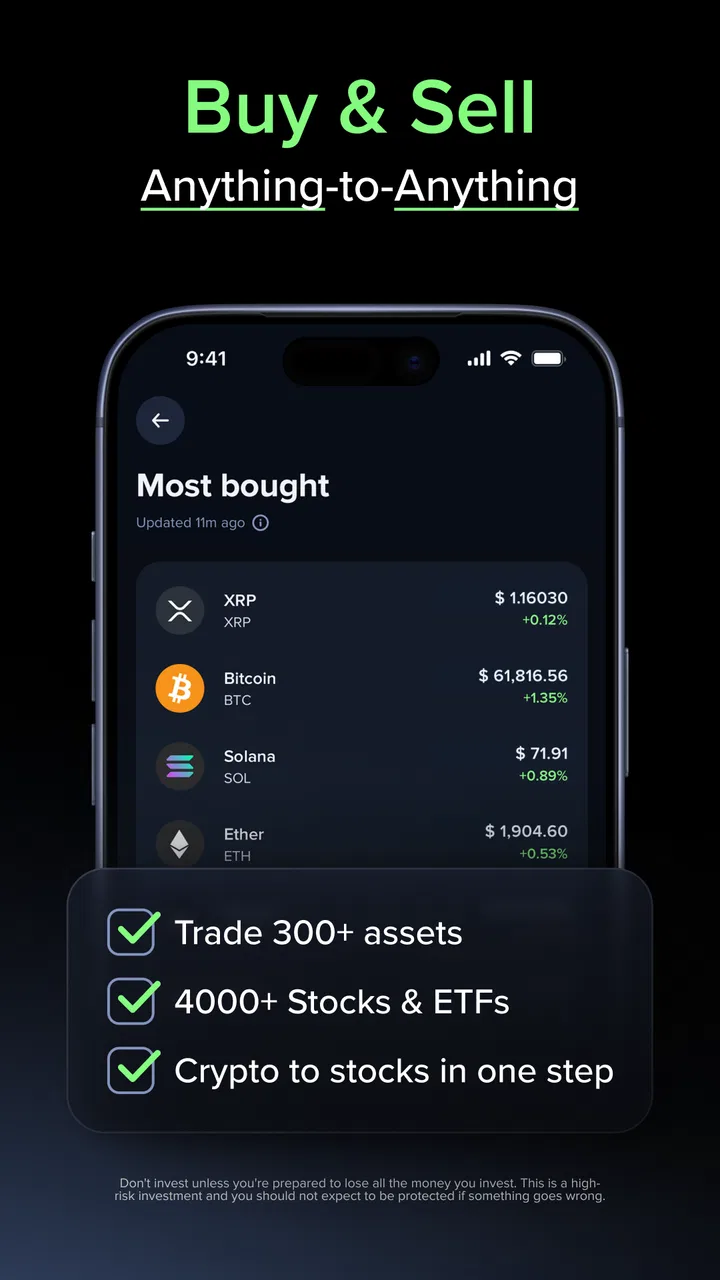
Uphold is a versatile financial platform that allows users to buy, sell, and exchange a wide range of digital currencies, including Bitcoin (BTC) and Ethereum (ETH). With access to over 300 cryptocurrencies, users can also trade precious metals and national currencies, making it a comprehensive tool for financial management and trading.
02Is Uphold secure for trading and holding cryptocurrencies?
Yes, Uphold employs a variety of security measures to protect users' assets and information. This includes two-factor authentication, encryption, and cold storage for digital assets. Additionally, Uphold is compliant with financial regulations, ensuring a secure environment for trading and holding cryptocurrencies.
03What are the fees associated with using Uphold?
Uphold offers a transparent fee structure. Trading fees are variable and depend on the specific currency pairs. There are no deposit fees for bank transfers, but other methods like credit cards might incur charges. It’s important to review the fees on Uphold’s website to understand the costs involved in transactions.
04Can I use Uphold to send money internationally?
Yes, Uphold allows users to send money internationally with ease. You can transfer funds to other Uphold users without any fees, and the platform supports a wide range of currencies. This makes it an efficient tool for cross-border transactions, with the added benefit of low-cost conversions.
05Does Uphold offer customer support if I encounter issues?
Uphold provides customer support through various channels, including email and an extensive help center with FAQs and guides. While phone support may not be available, the support team is responsive, and the help center is designed to assist users in resolving most common issues efficiently.
Pros
- Supports over 300 cryptocurrencies.
- User-friendly interface for beginners.
- Instant account setup and verification.
- Offers both mobile and desktop access.
- Low trading fees for frequent users.
Cons
- Limited advanced trading options.
- Some features require identity verification.
- Customer support can be slow.
- Not available in all countries.
- Occasional app performance issues.

Uphold: Buy BTC, ETH and 300+
Gallery